
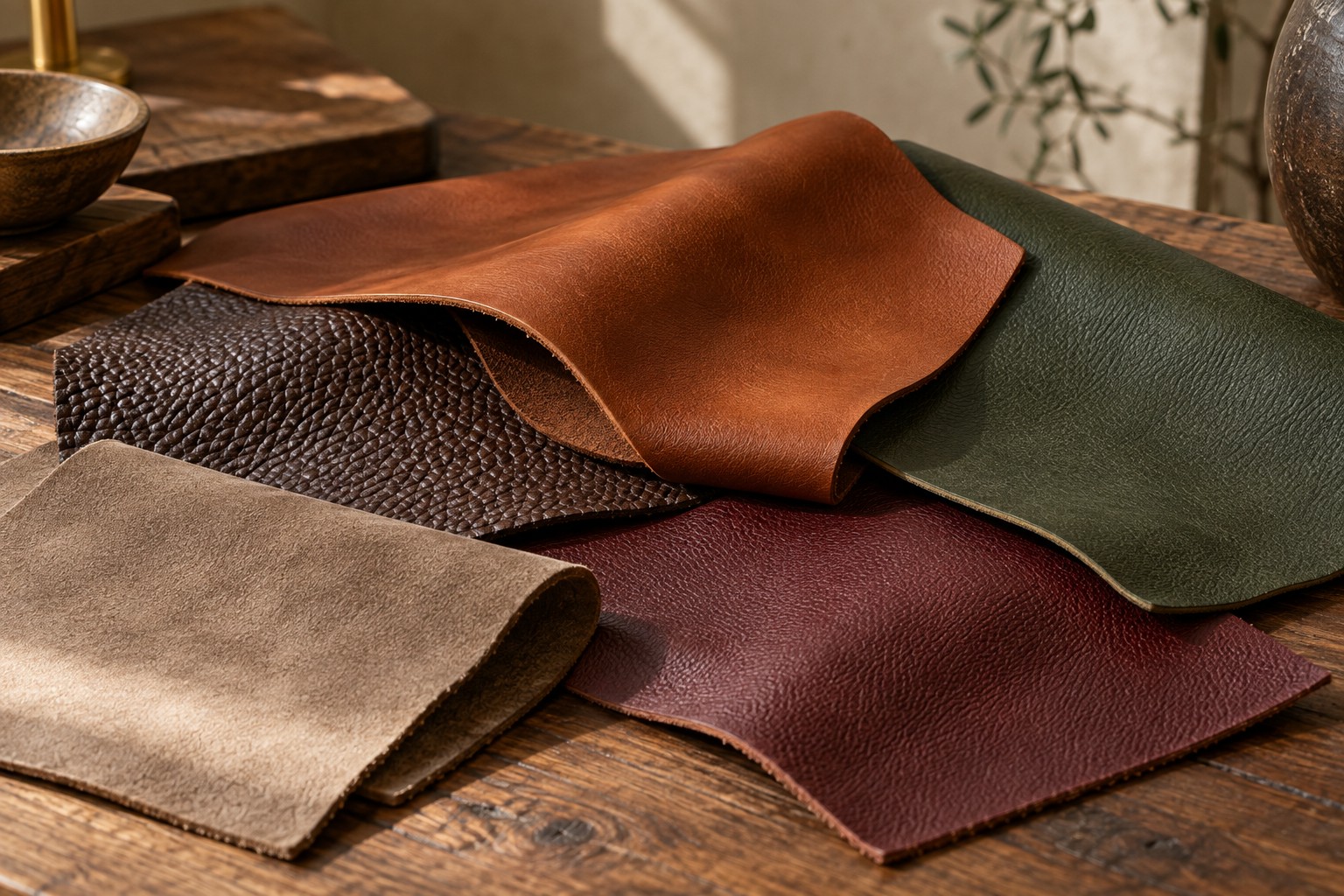
Selecting leather for a desk accessory, binding or box involves several separate criteria. Animal origin, hide layer, tanning and surface finish describe different characteristics. Full-grain leather can therefore be smooth or textured and can receive different protective finishes.
Full-grain and corrected-grain leather
Full-grain leather retains its grain without corrective mechanical removal of that surface. Corrected-grain leather has had its surface buffed or otherwise adjusted before finishing. These descriptions explain surface preparation, but they do not alone guarantee a finished product’s lifespan. Thickness, tanning, finishing and construction also matter.
Smooth and embossed leather
A leather’s texture may be natural or enhanced by finishing, including embossing. A textured appearance does not automatically mean corrected grain or inferior quality. A pronounced grain can suit a collection’s style, while a smooth surface may suit restrained decoration. Samples help compare the feel and the appearance of personalisation.
Split leather and bonded material
Split leather comes from the lower layer of a hide after splitting. It can have a surface finish or a suede appearance. Its suitability depends on the intended use. Bonded leather material contains leather fibres or particles held together with a binder; it differs from a tanned hide that retains its original fibrous structure.
Nubuck, suede and imitation suede
Nubuck is buffed on the grain side to create a fine nap. Suede has a napped surface on the flesh side or on a split. The French term suédine refers to a fabric imitating suede, rather than a leather type. This distinction is useful when specifying a box lining.
Surface finish and daily use
Aniline finishes reveal more of the natural appearance. Pigmented finishes add colour and surface protection. Stain resistance, feel and changes in appearance depend on the treatment. The tanning process also influences properties, but its name alone does not describe the performance of a finished leather.
Choosing leather for personalised products
For menu holders and desk pads, consider handling frequency and cleaning. For leather boxes, look at the covering, corners and lining. For bookbinding, thickness and flexibility should suit the binding structure. Discussing the use, colour and budget with Molacraft helps define the project.
Checking the material before ordering
Ask for the material and finish specification, and compare samples in neutral light. Smell or feel alone cannot establish leather origin or quality. For a series, agree on acceptable variations and care instructions. Any care product should suit the finish and be tested in an inconspicuous area.
Related articles
Care for leather accessories · Plan materials for a personalised box · Leather bookbinding: history and craftsmanship · Leather tanning: from hide to material
Further reading
Leather Working Group — Leather industry terms · Leather Naturally — Leather types and care · Le Robert — Suédine