
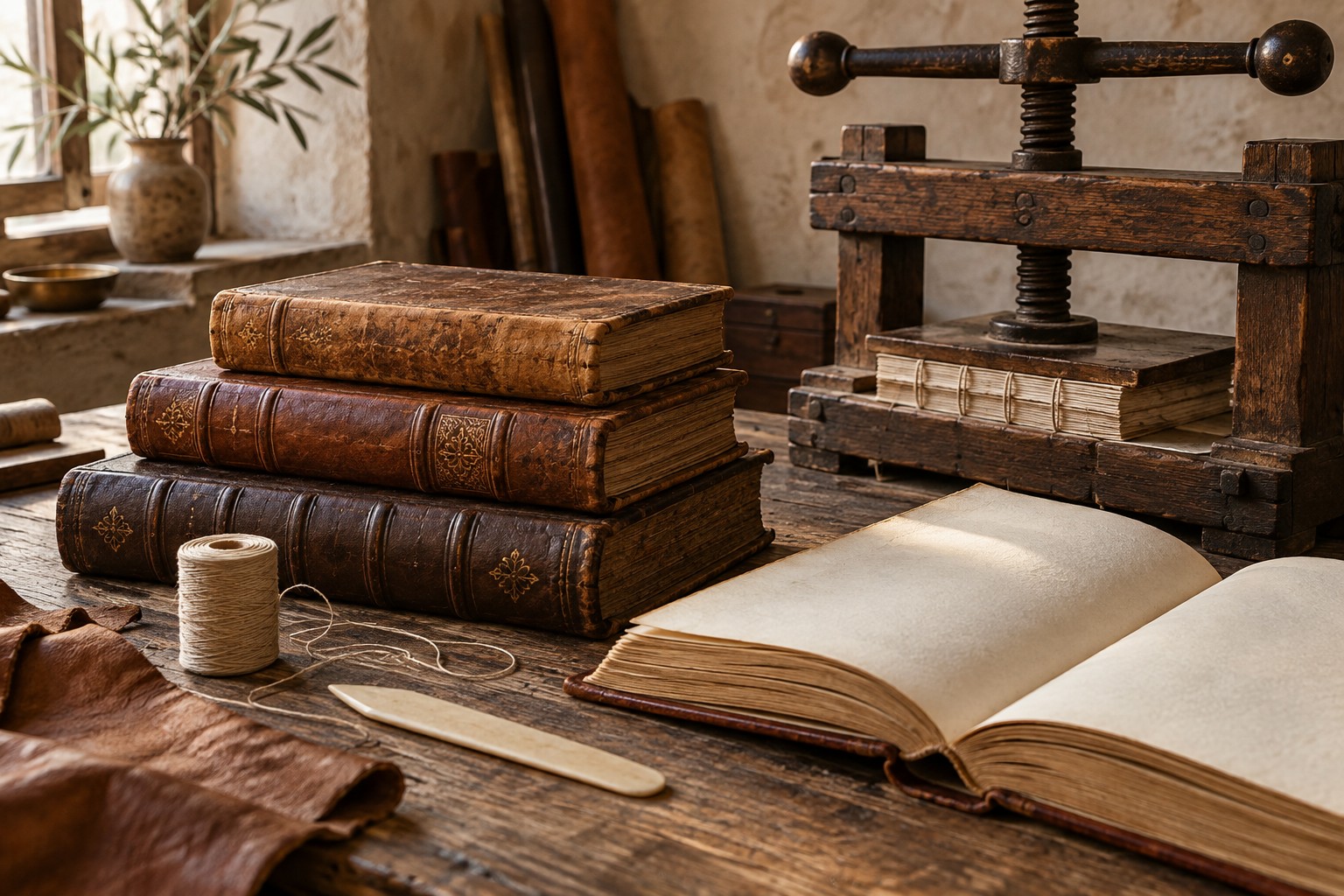
Handmade leather bookbinding protects a book’s pages while giving it a distinctive identity. Sewing, covering and decoration all shape the finished piece. For a special edition, register or leather guest book, quality also means an appropriate opening, a secure book block and a structure suited to its use.
From the codex to the bookbinding workshop
The codex, made from assembled leaves, gradually took its place alongside the scroll in antiquity. Its pages required a structure to hold and protect them. Surviving early bindings reflect different traditions, including those of North Africa and the Mediterranean; bookbinding history extends beyond European workshops.
Materials and decoration changed over the centuries. Printing and larger-scale publishing encouraged cheaper covers and mechanised processes. Hand binding retained a role for books whose presentation, format or finishing called for individual attention.
How a book is bound by hand
A bookbinder first considers the book block: its dimensions, thickness, condition and assembly. Depending on the project, sections are sewn, the spine is prepared and covering boards are fitted. Leather is cut, pared where needed and carefully applied. Endpapers and finishing complete the binding. Different binding structures require different sequences.
Decoration may include a title, lines, motifs or a name. Gold tooling may use gold leaf, while other marking processes use foil. Blind tooling creates an impression without adding colour. The method should suit both the leather surface and the character of the book.
Full leather and half leather: what is the difference?
A full leather binding covers the spine and both boards in leather. A half leather binding combines a leather spine, sometimes leather corners, with another covering material on the boards. Appearance, budget and use all influence the choice. Goatskin, calfskin and other leathers may be used; preparation and thickness also affect suitability.
Bespoke leather bookbinding for international clients
The Molacraft bookbinding collection applies this craft to leather-covered books, special editions and guest books. Made in Morocco for publishers, institutions, hotels and event organisers at home and abroad, each project is planned around its intended use. Dimensions, colour and personalisation help connect the binding to its setting; delivery destination and timing are confirmed in the quotation.
Preparing a custom bookbinding enquiry
Provide the book dimensions, quantity, page structure or condition, preferred finish and deadline. Include any text or logo to be assessed. Photographs and an example of the finish make the discussion easier. The workshop confirms the feasibility of the details before production.
Related articles
Create a personalised leather guest book · Choose personalisation for a leather binding · Leather types: how to choose for your project · Leather tanning: from hide to material
Further reading
Princeton University Library — The Early Codex and Coptic Sewing · Victoria and Albert Museum — Printing and binding a book